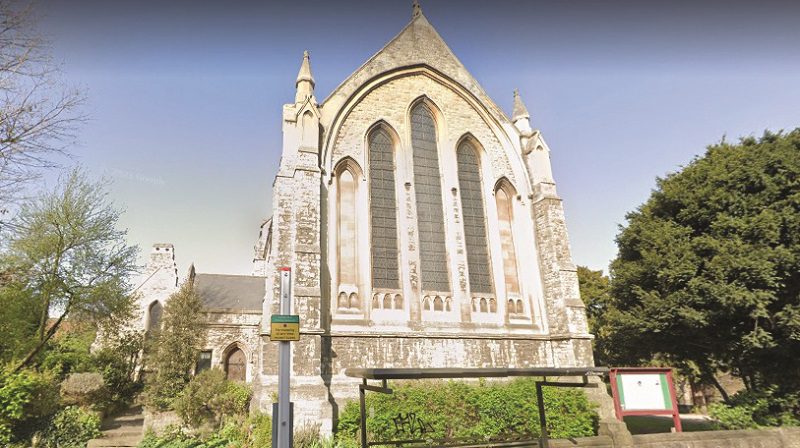
Did suffragettes try to burn down church?
On May 16, 1913, St Catherine’s Church, Pepys Road, Hatcham suffered serious damage as a result of fire, writes Julie Robinson.
But was it arson? And were the suffragettes responsible?
The event was widely reported in the national and international press including The Times, Daily Mirror, The Graphic and the New York Times.
At the time, it was assumed to be the work of the suffragettes who were well-known for using militant tactics to get the vote for women.
The vicar, the Rev HJH Truscott was in no doubt who was responsible.
All was well when he was at the church at 11.30pm, but 30 minutes later the building was ablaze.
He noted that the gas was turned off and the heating had not been used for two weeks, leading him to think the fire was deliberate.
The vicar told reporters that he was convinced the suffragettes were responsible because he had seen two women and a man hanging about outside the church, although there had been no service.
An employee at nearby Haberdashers’ Aske’s School raised the alarm. Despite the flames, the vicar was able to rescue the parish registers.
As the church is sited at the very top of Telegraph Hill, firefighters were hamstrung by the fact that water had to be pumped some distance up the hill.
Although no one was ever prosecuted for the fire, circumstantial evidence points strongly to the suffragettes.
Firstly, the church was burned down on the day when a Woman Suffrage Bill was voted down in the House of Commons.
Secondly, from July 1912, it was the suffragettes’ unofficial policy to commit arson and bomb attacks on buildings to put pressure on the insurance companies who it was hoped, threatened with the prospect of huge financial losses, even bankruptcy, would in turn put pressure on the Government to give women the vote.
In 1913, the arson campaign escalated to railway stations, cricket pavilions, racecourse stands and golf clubhouses.
In February 1913, suffragettes Lilian Lenton and Olive Wharry were arrested and convicted of setting fire to the tea gardens at Kew Gardens.
The cost of the damage was £900 but it was only insured for £500.
Later that year on September 5, someone tried unsuccessfully to burn down Dulwich College.
Suffragette newspapers were pinned to nearby trees with women’s hatpins. No one was ever arrested or convicted.
Another factor may have been the church itself. Although some suffragettes campaigned for the vote through their churches, eg The Church League for Women’s Suffrage, many saw the clergy as a male-dominated institution hostile to their cause.
Finally, after entering the building, firefighters identified the organ area as the point of origin of the fire.
A copy of The Suffragette newspaper dated April 25, 1913 was found among sheets of music in the church organ loft together with…some matches.
St Catherine’s Church, a local landmark, was built in 1983-4 by H Stock, surveyor to the Haberdashers’ Company and cost £18,000 – nearly £2.5million in today’s money.
It was erected in ragstone with a brick interior.
After the fire, it was rebuilt relatively quickly with funds raised by public subscription.
In the 1960s the church was reordered for combined church and community use.
Today it is home to the Telegraph Hill Centre which hosts many events for local residents from an annual charity book sale to fitness classes.
The centre also provides a valuable meeting space for people with addiction issues as well as other community groups.
Perhaps those suffragettes would be pleased to know that the current vicar, Revd Sheridan James, is the first female incumbent of the church and that the current congregation is a warm-hearted, diverse, welcoming group of worshippers from all around the world – committed to the local community and to social justice.