This week 10, 20, 30 years ago
10 Years Ago
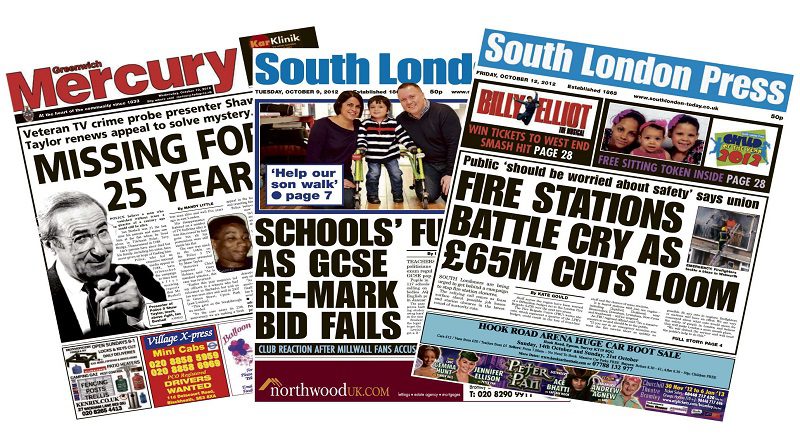
Six fire stations in South London were earmarked for potential closure under proposals to slash the London Fire Brigade (LFB) budget by £65m over two years.
A document seen by South London Press revealed Downham, New Cross, Southwark, Woolwich, Clapham and Peckham stations were on a hit list of 17 across the capital.
These closures would represent a budget cut of £25m and the loss of eight engines.
The document also showed 21 stations and 41 engines across the capital would be lost under cuts of £50m.
The number of long-term jobless young South Londoners increased since the start of the recession, figures revealed.
According to statistics released by youth charity The Prince’s Trust, the number of young people in South London aged between 18 to 24 claiming Jobseeker’s Allowance (JSA) for more than six months had risen by at least 165 per cent in the previous four years.
The South London Press announced it would leave its office in Streatham Hill after 73 years.
All editorial staff would relocate within Streatham by the end of March 2013.
Other departments would move to County House in Beckenham Road, Beckenham; chosen because it met the needs of a 21st century print media business.
Peter Edwards, South London Press managing director, said it was sad to leave the paper’s five-storey home in Leigham Court Road.
He said: “This building is iconic and served a superb purpose from the 1930s, but no longer does because of the way newspaper technology has moved on and the business has changed.”
20 Years Ago
Shocking figures revealed that South London topped the tables for infant mortality rates in the capital.
The figures showed seven children in every 1,000 born in Southwark, Lambeth and Lewisham did not make it to their first birthday – a rate one-and-a-half times higher than the London average.
Health bosses blamed the crisis on a trend of parents not getting their children immunised against common childhood illnesses.
The Department of Health released the figures, which showed a marked contrast in infant mortality between neighbouring boroughs between 1993 and 1998, pointing to social deprivation as being a direct cause.
A group of neighbours vowed not to throw in the trowel in their fight to save their “outlawed” flower display.
The residents of Stonell’s Road in Battersea launched a bid to have their cul-de-sac turned into a private road to save their plants.
Despite winning a London in Bloom Award, one resident had been ordered to get rid of the plants because Wandsworth council said they were blocking a public highway as motorists needed to be able to use the road as a turning circle and it had received complaints about the size of the display in one of the front gardens.
Thirteen men were dragged before the courts following a crackdown on kerb-crawlers.
Lambeth police mounted a sting operation in Garrad’s Road, Streatham October 2002, leading to the arrests.
The men appeared at Camberwell Green Magistrates’ Court where they were fined between £100 and £200.
30 Years Ago
A council came under fire after it emerged that it had paid an employee £100,000 to stay at home and do nothing – for five years.
The former Lambeth council housing officer had kept her £20,000-a-year salary despite having lost an employment tribunal case against her bosses.
Angry opposition Tory councillors demanded an inquiry.
The housing officer accused the council of racial discrimination after being passed over for a promotion.
She had been short-listed for the job but had not been chosen.
The claim was rejected but the decision was later overturned, with a panel of councillors and trade unionists ruling that she should be offered a promotion.
But for five years she refused everything offered to her.
A council’s plans to sell a £70,000 building for £1 were scuppered by the Government.
Southwark wanted to sell a 125-year lease on the empty school prefab building on the condition that it was used as a mosque and Islamic cultural centre.
But the Department of the Environment vetoed the move to sell the dilapidated building in Choumert Grove, Peckham to the Islamic Centre Mosque Trust.
The council argued that turning the building into a mosque effectively devalued it by £69,999 but opposition councillors slammed the scheme as the trust had already been given two-year planning consent to use the building.
Conservationists mounted a campaign to save a disused power station from demolition.
Southwark’s Tory leader Councillor Toby Eckersley appealed to the new National Housing Minister Peter Brooke MP to preserve the Bankside Power Station in Summer Street, Southwark.
He claimed that the building’s tower was as much a landmark on the Thames as Battersea Power station which had been listed for the past 12 years.
But the power station’s owner Nuclear Electric applied to Southwark council to demolish one of its walls so that it could remove some machinery.
The power station had been decommissioned in 1981 but used as a switch station.
Main Picture: South London Press Publications

The Department of Health failed to consider the impact of the emissions from the SELCHP incinerator on increasing rates of infant mortality after that incinerator started operating in 1993. After ONS released the infant mortality rates in all London Boroughs from 1970 to 2010 in December 2012, I produced a graph showing the infant mortality rates in the Boroughs of Lewisham, Newham, Tower Hamlets and Wandsworth all falling at a similar rate and all very closely matched until the SELCHP incinerator started operating. After 1993. the rate of infant mortality in the Boroughs of Lewisham Newham and Tower Hamlets suddenly rose whilst the rate in Wandsworth, which is rarely exposed to emissions from SELCHP continued to fall. The Department of Health was asleep in the above South London Press article of twenty years ago and remains in deep negligent slumber on the incinerator issue today. The should have woken up with the incinerator article by Julia Lewis in the South London Press on 4 May 2007, which reported a huge imbalance in the infant mortality rates between electoral wards upwind and downwind of the incinerator (2003-2005 ONS data)