“I’m finding it hard to show empathy through masks – I rely so heavily on my facial expressions”
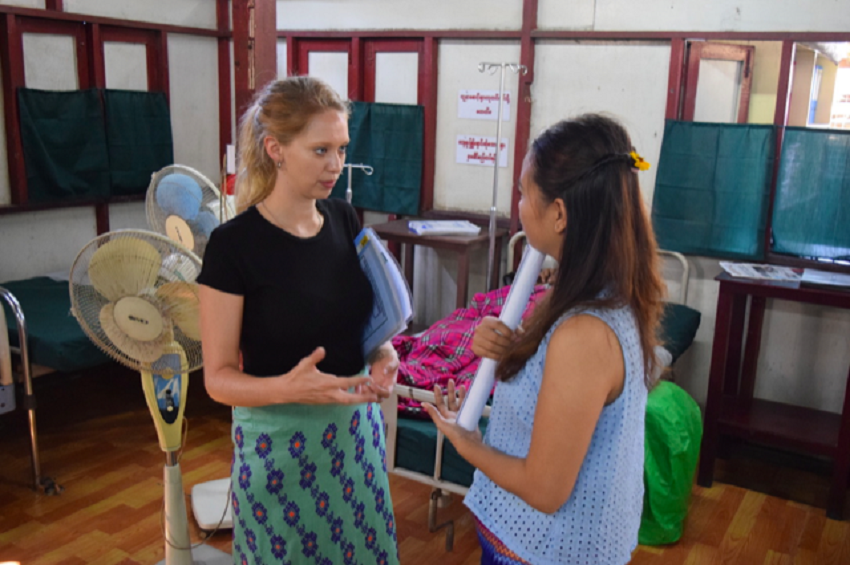
Richenda Browne 29, from Forest Hill, was on duty during the London Bridge attack in 2017, and has worked at King’s College Hospital in Camberwell for five years. She has just been promoted to junior sister/trainee team leader. She said: ‘I’m trying to treat it like a humanitarian mission’ – as she has first-hand knowledge: she worked for INGO Medical Action, which provides over a million health consultations per year to the poorest families in Myanmar.
One of my roles at King’s College Hospital involves liaising with families during their darkest hours of need.
But everything I know about being there for people feels different because of how infectious coronavirus is.
Recently, a woman distraught with grief came to the hospital and told me she was desperate to see her husband. I had to be blunt about the risks to her health. She told me her son had begged her not to come but her husband was dying and she had to be by his side.
Helping families who can’t be together in these moments is upsetting. I stay strong for my patients at work, but at home, on rare days off, I process everything. We need to think of innovative ways for people to communicate with patients in isolation, such as using video calls to say goodbye. I’m also finding it hard to show empathy through masks – I rely so heavily on my facial expressions.
What’s really worrying is how hospitals are running low on protective equipment. The Government urgently needs to prioritise getting more. Healthcare workers are the most precious commodity the country has right now. To protect them, I’ve stopped seeing family and friends and can’t bear to think how long this might go on for – I’m trying to treat it like a humanitarian mission.
We’re discovering new things every day about this disease: most patients with symptoms have been over 40. We’ve also been surprised how quickly some people’s breathing seems to deteriorate. After having symptoms for five to seven days, those who are going to develop severe illness can quickly go downhill.
I have always wanted to be a nurse. I see it as a privilege to help people, often when they are at their most vulnerable.
Before this, I worked on a specialist infectious diseases ward, also in South London, treating patients with TB, HIV and other communicable diseases. The main difference is that we knew what the patients had or were suspected to have, and we knew how to protect ourselves with PPE.
We have all been overwhelmed with the generosity from local businesses, restaurants and individuals with food donations and kindness. We are so grateful for the support we have received from the local community – it makes this difficult job a tiny bit easier.
The only way we can get through this is from the understanding we have as a team and the support we give each other. I rely on the mutual understanding and humour shared between colleagues – and the amazing love shown from my family and friends. I am abiding strictly to the lockdown rules, but still speaking to them regularly.
The NHS functions because everyone works hard together. It’s not just clinical staff working flat out, but the porters, housekeepers, security, customer care officers, lab technicians, managers, physios and occupational therapists are pulling out all the stops to help keep everyone safe.
Everyone’s roles are essential, especially in these challenging times.
In Myanmar, I was responsible for supervising and training nurses across five clinics in the most deprived areas of Yangon. I am treating this like working abroad, mainly because I am unable to see my family and friends.
But I do have the luxury of the resources of the NHS. I really worry how other low and middle-income countries will cope with poor healthcare.
I guess this is a reminder of how lucky we are to have free treatment in the UK.
If we take anything away from this, we should try and treat each other with more compassion, look after our local communities, and not take the NHS for granted.
Pictured top: Richendra Browne, left