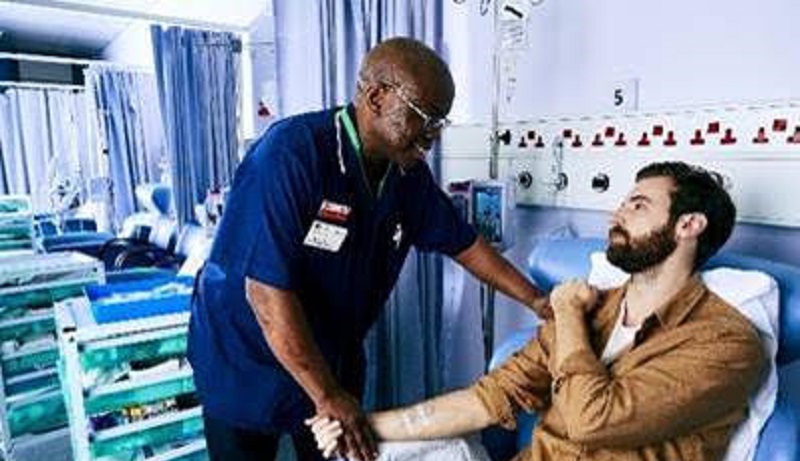
Wimbledon man highlights cancer care gaps in charity photoshoot by singer Sophie Ellis-Bextor
With new analysis from Macmillan Cancer Support finding that 1 in 5 London cancer patients feel there aren’t always enough nurses to care for them in hospital following an operation or overnight stay, Justin Robertson (26) from Wimbledon, who was diagnosed with testicular cancer at the age of just 24, has been sharing his fears for fellow cancer patients.
Justin, who is now in remission, was part of a photography shoot by Sophie Ellis-Bextor and celebrity photographer Nicky Johnston. The shoot brings to life some of the ‘support gap moments’ for people living with cancer and is a collaboration with Macmillan, as part of the charity’s #SaveOurSupport campaign.
The singer’s stepfather and grandparents have been affected by cancer and supported by Macmillan.
Justin spoke about his concerns for the future of cancer care:
“If I’d have gone into a treatment room and there hadn’t have been the specialists that were there for me, I would have been a lot more nervous, a lot more scared and a lot more anxious.
“Not only in the moment of having the treatment and sitting watching the drugs pour into my system, but also scared of what was going to happen afterwards. Having someone there to reassure you when things get hard and that their support will continue to be there – that’s something that I’ll always be thankful for.
“With the ongoing pressures on the NHS, I think it’s a scary time for people who might be experiencing cancer and going through treatment. Which patients in the future might not be able to receive that same level of support I had?
It’s a really daunting prospect that, without the funding and without the support, the level of care and attention that Macmillan and the NHS want to provide might ultimately not be able to continue in the same way.”
Singer Sophie Ellis-Bextor, whose stepfather John has stage 4 lung cancer and is being supported by Macmillan, says:
“Cancer can be absolutely devastating – not just for the person experiencing it but also for their family and loved ones. Without someone to reach out to for help when it comes to medical, emotional or financial worries, people can feel absolutely desperate.
“I know from my own experience that Macmillan professionals are the rocks you cling onto when everything else seems so uncertain. Meeting staff and patients while taking these photographs underlined just how vital that support is.”
Thousands of people diagnosed with cancer in London – at least 12,700 a year[iii] – are being ‘left in the dark’ as they miss out on key information, amid record NHS vacancies and unmanageable staff workloads across England, a leading cancer charity has warned today.
New figures from Macmillan Cancer Support reveal around one in six (17%) of those recently treated for cancer – around 5,200 people each year in London alone – did not have their treatment options fully explained before starting treatment.
Meanwhile more than 1 in 4 (27%) – around 8,500 people a year – did not have the possible side-effects of treatment fully explained before starting treatment, and more than a third (41%) – around 12,700 people each year – said the longer-term side-effects of treatment were not fully explained.
Macmillan warns that without this information and support, patients may feel uncertain about treatment, feel forced to give up a job they love or feel unsure about how to prepare for the impact cancer might have on them physically, financially and emotionally.
The analysis of a survey of cancer patients across England also reveals that in London around 1 in 14 (7%) – around 2,000 a year – didn’t receive the name of a Clinical Nurse Specialist who would support them through their treatment.
In addition, 1 in 5 (22%) – around 6,800 people in London – didn’t receive, but would have liked information about financial support available, and around 1 in 10 (11%) – around 3,500 people – didn’t get, but would have liked information about support or self-help groups for people with cancer.
The analysis also shows that in London 1 in 5 (18%) people recently treated for cancer – around 5,700 people a year – say there weren’t always enough nurses on duty to care for them in hospital following an operation or overnight stay. And around 2,200 people a year who had an operation or overnight stay could not find any hospital staff at all to talk to about their worries or fears.
The charity, which has more than 100 years’ experience providing emotional, physical and financial support to people with cancer, is warning the situation is being exacerbated by a lack of Clinical Nurse Specialists who can provide expert advice, specialist care and signpost people to support.
Lynda Thomas, Chief Executive at Macmillan Cancer Support, says:
“A cancer diagnosis turns your world upside down, and navigating the maze of hospital appointments, scan results and treatment plans can be overwhelming without support.
“We know staff desperately want to provide a listening ear or a hand to hold, but with understaffed wards and a critical shortage of specialist cancer nurses, it’s hardly surprising that patients will feel left in the dark – sometimes even when it comes to the critical information about their disease.
“The staffing crisis is eating away at the very core of our NHS and patients and staff deserve better. Only a clear plan to grow and train the cancer workforce will help us escape this downwards spiral.”
To see Macmillan’s photography series and find out more about the charity’s Save our Support campaign, visit macmillan.org.uk/sos
Ellen Lang, a nurse who manages the Clinical Information and Support Team on Macmillan’s Support Line, says:
“When people hear the word “cancer” they often hear little else after that. Having someone who can talk you through side effects or how a diagnosis will affect your life are the basics, but they make the difference between someone feeling like they understand what is going on and getting the personalised care they need, and someone feeling completely lost.
“We get calls every day asking us to fill in the gaps for them – everything from what their stage or grade of cancer means or if they’ll be too ill to do the school run following their chemotherapy. In a busy clinic with a lack of specialist cancer nurses, this is something hardworking NHS staff simply don’t have the luxury of providing.”